
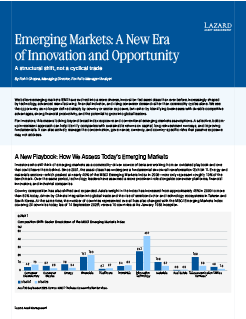
Emerging markets have undergone a structural transformation, with innovation, advanced manufacturing, digital finance, and rising consumer demand increasingly displacing commodity-driven growth as key sources of opportunity. Investors may benefit from looking beyond broad country and sector classifications to identify companies with durable competitive advantages, high and sustainable returns on capital, and long reinvestment runways. Given the diversity of emerging markets, a selective bottom-up approach can help manage the playbook.
Executive Summary
We believe emerging markets (EM) have evolved into a more diverse, innovation-led asset class than ever before, increasingly shaped by technology, advanced manufacturing, financial inclusion, and rising consumer demand rather than commodity cycles alone. We see the opportunity as no longer defined simply by country or sector exposure, but rather by identifying businesses with durable competitive advantages, strong financial productivity, and the potential to grow into global leaders.
For investors, this means looking beyond broad index exposure and conventional emerging markets assumptions. A selective, bottom-up investment approach can help identify companies with sustainable returns on capital, long reinvestment runways, and improving fundamentals. It can also actively manage the concentration, governance, currency, and country-specific risks that passive exposure may not address.
A New Playbook: How We Assess Today’s Emerging Markets
Investors who still think of emerging markets as a commodity-driven source of beta are working from an outdated playbook and one that could leave them behind. Since 2001, the asset class has undergone a fundamental structural transformation (Exhibit 1). Energy and materials sectors—which peaked at nearly 40% of the MSCI Emerging Markets Index in 2008—now only represent roughly 10% of the benchmark. Over the same period, technology leaders have assumed a more prominent role alongside consumer platforms, financial innovators, and industrial companies.
Country composition has also shifted and expanded. Asia’s weight in the index has increased from approximately 45% in 2000 to more than 80% today, driven by China’s integration into global trade and the rise of semiconductor and technology ecosystems in Taiwan and South Korea. At the same time, the number of countries represented overall has also changed with the MSCI Emerging Markets Index covering 24 countries today, versus 10 countries at its January 1988 inception.
EXHIBIT 1
Composition Shift: Sector Breakdown of the MSCI Emerging Markets Index
As of 30 September 2026. Source: MSCI. *Includes Communication Services.
The index’s size and top ten constituents today bear almost no resemblance to those of twenty-five years ago. In our view, this is not a cyclical rotation. It is a structural shift in what emerging economies produce, export, and where they sit in global value chains—and we believe it demands a different approach from investors.
A Firm Foundation Starts with Productivity
The shift in emerging markets sector leadership became even more pronounced after the global financial crisis (GFC). Prior to the GFC, EM investment returns were primarily driven by growth in tangible assets like natural resources, infrastructure, and real estate. And capital, which was scarcer in the regions than it is today, was the key determinant of a competitive advantage. That is no longer the case: Post-GFC, ultra-cheap global liquidity made capital abundant for nearly everyone, helping to shift the sources of competitive advantages.
Emerging markets have evolved significantly. The potential opportunity lies in looking beyond traditional classifications to better capture the diversity of countries and sectors within the asset class.
Today, value is increasingly created through intangible assets: proprietary technology, management quality, network effects, brand equity, and human capital. In some industries, EM companies are not merely catching up to their developed markets peers—in many areas, they are surpassing them.
Because the old proxies no longer signal an advantage, this shift requires investors to take a fundamentally different analytical lens to the asset class. The most important question an investor can ask about an EM company today is not where it is headquartered or what sector it occupies. It is whether it can generate high and sustainable returns on equity and invested capital—what we call productivity—and whether the market has correctly priced that capacity.
A Nuanced, Phased Framework
Emerging markets are not homogeneous. One of the most persistent—and potentially costly—mistakes investors can make with the asset class is treating it as if it were a monolith. The 24 countries and approximately 1,200 companies in the MSCI Emerging Markets Index represent an extraordinary range of economic structures, development stages, regulatory environments, and competitive dynamics.
Mapping companies by their position in the economic development cycle—rather than through rigid sector and country classifications—reveals how much conventional labels can obscure. Within financials, for example, a bank still expanding basic account penetration and a decentralized-finance platform disintermediating that same bank may share an index classification, yet represent fundamentally different investment propositions.
Also, a bank meeting basic deposit and credit needs may sit at an earlier stage of development. By contrast, a fintech offering digital banking or mobile-payments infrastructure that expands financial inclusion at scale may operate at a more advanced stage. Looking beyond sector and country labels to where a company sits on the development curve is therefore essential: that position shapes not only the scale of the opportunity, but also the variables that drive returns and the risks that matter most.
Together, these signals point to new opportunities.
And within this framework, we focus on two distinct sources of potential investment returns:
- Compounders: High-quality businesses with durable competitive advantages and long reinvestment runways. These companies sustain high returns on capital well beyond what the market expects, compounding earnings through economic cycles. The market systematically undervalues them by assuming competitive forces will erode returns more quickly than they actually do.
- Mispriced Stocks: Companies where (a) financial productivity is set to improve materially—through management-driven operational change, restructuring, or a favorable shift in market dynamics—and (b) the market has not yet reflected that improvement in the share price. These opportunities tend to have shorter holding periods, but the return potential when re-rating occurs can be significant.
Combining both types—rather than committing to a single opportunity—is how we construct a portfolio designed to deliver consistent outcomes across different market environments.
With Opportunity Comes Responsibility
Emerging markets investing requires a clear-eyed view of risk—political, governance, currency, and, perhaps most underappreciated, concentration. As bottom-up, fundamental investors, we are selective about the companies we own and why we own them—our positions reflect conviction in specific businesses, not the gravitational pull of index weights.
Governance, for example, is central to that conviction. Controlling families, super-voting structures, and state influence are structural features of emerging markets, not anomalies—and they determine how a company’s returns are ultimately allocated. We treat governance as core to the investment case, which is why we favor active, long-term ownership: It gives us standing to hold management accountable on capital allocation and the governance and sustainability risks that could erode the thesis.
The Opportunity Investors Can’t Afford to Miss
Digital finance, AI and semiconductor infrastructure, transport electrification, and a more affluent consumer class are just some structural themes that are playing out across dozens of emerging economies at once. Investors who approach these markets with a sufficiently nuanced framework and understanding will, we believe, capture opportunities that passive exposure to the benchmark will be hard-pressed to deliver.
Emerging markets is an asset class that no longer fits in a single style box. It rewards investors willing to understand it on its own terms. There is now a real scope of opportunity for investing in businesses that will transcend their emerging markets title and become top multinational companies in the future. This is an opportunity we at Lazard believe investors cannot afford to miss.
Related Resources
Emerging Markets: A New Era of Innovation and Opportunity



Emerging markets have undergone a structural transformation, with innovation, advanced manufacturing, digital finance, and rising consumer demand increasingly displacing commodity-driven growth as key sources of opportunity. Investors may benefit from looking beyond broad country and sector classifications to identify companies with durable competitive advantages, high and sustainable returns on capital, and long reinvestment runways. Given the diversity of emerging markets, a selective bottom-up approach can help manage the playbook.